• Zum Hauptinhalt springen
  • Zum Footer springen

DFG-Forscher...

  • About
  • News
  • Projects
    • Project 1 - Development of a Gene Therapy for Usher Syndrome Type 1B (USH1B)
    • Project 2 - Evaluation of novel gene therapy approaches for USH2A
    • Project 3 - Retina organoids as models for assessing pathomechanisms and effects of novel treatments inn retinal disorders
    • Project 4 - Development of a one-time gene therapy for age-related macular degeneration
    • Project 5 - Development of novel gene therapy strategies for treatment of autosomal dominant retinitis pigmentosa in a pig model
    • Project 6 - Novel targets for gene therapy in diabetic retinopathy (DR)
    • Project 7 - RPE plasticity in the context of neurodegenerative disease: Understanding the limits, pushing the boundaries
    • Project 8 - Novel AI-based biomarkers for retinal gene therapy outcomes by integrating functional neuroimaging and retinal imaging
    • Project 9 - Integrating imaging, clinical and genetic data with machine learning to establish biomarkers for retinal diseases
  • Project leaders
  • Publications
  1. DFG-Forschergruppe 5621
  2. Publications
  3. Dual AAV vectors for efficient delivery of large transgenes
press releases | 11/09/2025
Nature Protocols

Dual AAV vectors for efficient delivery of large transgenes

Mittas et al.
PMID: 40935897 DOI: 10.1038/s41596-025-01243-8

Abstract

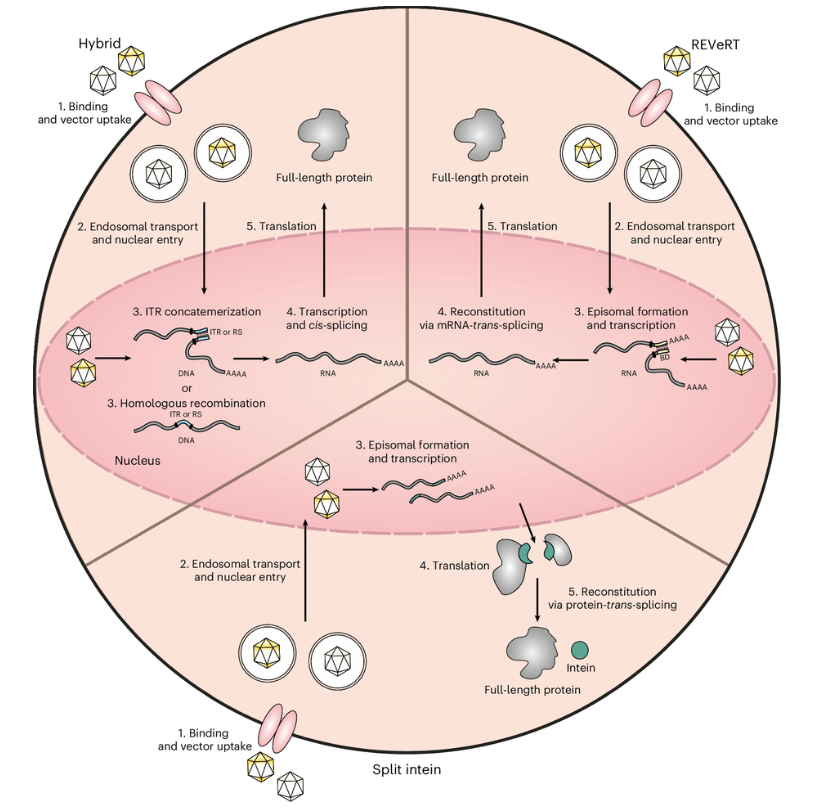
Despite their limited cargo capacity (<5 kb), adeno-associated viral (AAV) vectors remain the gold standard for in vivo delivery of therapeutic genes. Dual AAV vectors have emerged as a valuable tool for delivering large therapeutic genes and CRISPR tools to overcome this limitation. Here we provide a detailed protocol for the design, production and evaluation of dual AAV vectors. We offer guidelines for selecting a suitable dual AAV strategy, designing and cloning the genes to be delivered, and conducting in vitro evaluations of expression efficiency. In addition, we detail the production of dual AAVs and their assessment in human cellular models, such as induced pluripotent stem cell-derived retinal organoids. Finally, we outline the administration of dual AAVs via different routes in mice and the assessment of transgene-derived RNA and protein expression in various tissues. Overall, the instructions in this Protocol will aid in the efficient in vivo delivery of large DNA fragments using dual AAVs. This Protocol is adaptable to a wide range of model organisms as well as to human organoid cultures and, depending on the application, can be completed in 15–44 weeks.

  • View on pubmed
  • View on nature.com

All DFG-Forschergruppe 5621 Press Releases

FOR 5621 Research unit

Coordination

Mathildenstr. 8
80336 Munich
+49 89 2180 77337
wWüp6412vim ful_vfiuyziu-mi
Editor login
Imprint | Data-Safety